Showing posts with label Jordan. Show all posts

Thursday, June 12, 2014

Jordan: Kharak, Azraq and Amra

To the east of Jordan are a collection of buildings referred to broadly as "the desert castles". As these were things I was meant to see with Mikie the day prior, I could hardly enlist his services for exactly the same thing two days in a row without presumably having to answer some awkward questions from Farajat about time management. To work around this, I went to a different hostel and arranged it through them as a walk in...

... for considerably less.

That said, I was pretty sure that this would be all that is on the label and not a smidgeon more. Certainly no unanticipated overland adventures to somewhere else entirely.

Kharak isn't a castle. It's a squat, blocky building on a hill that is believed to be an ancient inn. I'm there with only my driver and a security guard. The guard follows me around, dropping an occasional english word like "stable", "window" and "old hotel".

Kharak: A medieval Holiday Inn.

It's a little eerie being followed by a guy in some dark ruins as he chain smokes and fiddles with his holster, but whatever, the broken English and offer of a durrie won me over.

Amra is a world heritage site and also not a castle. It is however in a desert. 1/2 is enough to earn the tag, I guess. Amra used to be a middle eastern hunting lodge/holiday house and probably had something to do with the extinction of the oryx. Undergoing some pretty hefty repair work and restoration, the murals inside were covered with plastic sheeting and scaffolding but from what I could see in the uncovered areas, it looked OK and probably would have excited historians/archaeologists a lot. The rounded roof and surrounding desert (plus oppressing heat) does give it a very Tatooine-like feel.

Mill and well, adjacent to the lodge at Amra

Azraq is probably Jordan's biggest natural disaster. A former oasis, water through the 20th century was pumped to a growing Amman, effectively depressing the water table at the oasis. Farmers in the region, running scarce of water due to this, sunk more wells illegally, something that further assisted its depletion, ultimately drying up the oasis. Plants died, birds and other animals left and the ecosystem was effectively broken. Worse still, when the Jordaninans realised the problem, their first solution was to just stop pumping water out but otherwise do little, thinking that nature would sort itself out (perhaps they subscribe to Dr Malcolm's belief that "life finds a way"?).

As the water table rebounded, salinity became a problem.

Now, in what seems like a remarkable and cruel irony, Amman - an already water strapped city in the middle of a desert - pumps freshwater to Azraq as well as aids re-vegetative efforts. This would all be great, were it not for the now larger number of illegally sunk wells in the area.

Oh yes, there is actually a castle here too.

Unlike the sand castles that are Kharak and Amra, Azraq is exotic and black, owing to its bricks being basaltic. It's a ruin. There's not much to it really... and while it's certainly cool, it's just not Petra or Jerash.

Castle? It seems to just be a really big yard with walls...

Sunday, June 8, 2014

Jordan: Wadi Rum


Being draped over and in between seven hills, Amman is understandably pretty good at redirecting and funneling water due to all this natural relief.  After 18 hours of reasonably heavy rain, the valleys between these hills – notably where I was staying – succumbed to flash flooding. Sewers burst, roads impersonated white water rivers, cars stood still.

I was going nowhere.

Many hours after the rain stopped and two thirds the way up one of the hills... there is still a torrent of water.


You can’t get around, much less change weather like this. Taking it in my stride, I went out for breakfast that turned into lunch; my vantage point from the first story of a cafĂ© afforded views of pedestrians getting sprayed by cars driving past. I wasn’t about to give up entertainment quite as good as that in a hurry. Without much of a second thought given to how long I might be able to sustain myself on Turkish coffee and felafel, the meals came and went while I alternately wrote, read and eavesdropped. I’d lost a day. It wasn’t a disaster but it was certainly undesirable. That morning I’d intended to head to Wadi Rum for two days before moving on to Egypt. Being 300km away down some rather treacherous roads, this as far as a plan went had to be totally abandoned now, which was truly a shame.

Wadi Rum was basically the place that sold me on Jordan. Petra is brilliant – make no mistake – but travelling this far for one reason was never going to be enough. Wadi Rum supplied that second reason in abundance. Famed for being Lawrence of Arabia’s refuge during his involvement in WWI, it is an expansive series of canyons inhabited by the Bedouin and recognised by UNESCO as a World Heritage site for both its cultural and natural value. The prospect of camping out under the stars after riding a horse around for a day was pretty exciting.

The following day after the streets cleared up and Amman got moving again I was held up getting out the hostel by Mikie also having to take two Danes to the airport at midday. This was a nuisance as I’d essentially paid for his time for the day and already lost half of it. The plan became dropping them off before then heading east to visit some desert castles; Kharak, Azra and Amra. As we’re leaving the airport he turns to me and says, “You like the deserts, not the oceans or the ruins. I can see it in you. I’m taking you to Wadi Rum.”

At this point it’s about half past twelve and that’s tantamount to suggesting, “let’s go to the Dongara Bakery for afternoon tea,” except that the roads are a minefield of pot holes and the drivers suicidal. Naturally, I indicated that this was more than OK by me.

The three hour drive passes almost without event. At Ma’an there are APCs and tanks stationed along the highway due to two fighting tribes in the area. This is the only interruption to otherwise sandy and slightly undulating desert… it’s hardly blow-your-socks-off awesome.

Out of nowhere we come to the edge of the desert – all along a plateau, apparently – and descend into a canyon with mesas dotted around it showing two very different packages of sedimentary rocks. It’s beautiful… and we’re not even there yet.

Rum village (find me a better name for a town) is situated in a tributary canyon to Wadi Rum. It’s about a twenty five minute drive off the now impressive highway. All the way there the mesas and canyon walls encroach on the canyon floor and road, not enough to leave anyone claustrophobic but it lets you know just how small you are.

It’s great.

It’s 4pm. At the gates to Wadi Rum, Mikie does something heroic/dodgy; he name drops a higher up at Rum and then bluffs making to call that person. The guy at the gate panics. Entry fees are waived and we get a private tour for a relatively nominal amount.

Mikie (left) and our driver.

 The driver takes us into Wadi Rum with a tray back 4x4. The tray has been re-purposed with bench seats and a precarious looking canopy. I sit on a cushion and bounce around. Only the Bedouin can drive in Wadi Rum and only 600 4wds are licensed for Wadi Rum each year, supposedly to minimise environmental impact. The licensing criteria for vehicles doesn’t appear to be terribly exacting… and in truth, nor does it seem too demanding on standards of driving. A point to consider might involve establishing some sort of rules for driving in Wadi Rum, particularly around speed or track use… but this is a start, I suppose.

Why bother with just one track?
 
We initially go to a spring where TE Lawrence bathed, then to a Siq, a dune behind a small mesa and then finally an ancient Bedouin carving depicting the area. I suppose these things are cool to historians and archaeologists (and sure, they are interesting) but in all honesty, just two hours of driving around and simply looking was going to leave me more than happy.

To be fair  to Mr Lawrence, this is not a bad bathtub view.
 
Where Hiba gets a five time daily hit of happiness through prayer, this and the memory of it is going to do me quite fine for a while yet.

There’s a story of a man who recently got lost hiking in Wadi Rum. The Jordanian and Saudi armies were dispatched in search of him, as well as Bedouin guides and trackers. They found him – healthy and in good spirits – days later in Saudi Arabia. If he is anything like me, he wasn’t lost at all, he just didn’t want to go home.
Yes, it's pretty enough.

Thursday, May 29, 2014

Jordan: The Dead Sea

The Dead Sea is surely the place all lifeguards aspire to a posting at; Eurotrash in skimpy swimwear and a straight up inability to sink. If you drown here, it's because you're trying. Of course, the harsh part of this reality is the middle aged, over weight, ghost white Russkis in speedos whose behaviour is akin to kindergartners in a playground... but that can be kind of funny too.

Good...

... good god.

It's a strange sensation, bobbing around in water that seems to want to foist you out. In five feet of water it was a struggle to put any part of my foot down, the second my center of gravity moved ever so slightly outside of straight down I would tumble up, rolling forwards or backwards depending on which direction I lost my balance.

I need a newspaper.
The hotels and government have the racket here sussed. 20JD is the starting price for access to a developed beach. It goes as high as 100JD (roughly $200AUD). The undeveloped beaches are accessible but come with no fresh water, something you need for a shower later. Paying somewhere proximal to forty dollars to go to the beach is something a little bizarre for me, and to also have access to three decadent pools atop the shore seemed a little... ridiculous? Whatever the case, it's very much the norm here.

Halite crystals are washed up on the shore, beds of halite are apparent as you walk out, indicating past shorelines and the retreating nature of the Dead Sea. It's super saturated salt water and it sets all my mosquito bites on my legs and arms absolutely alight. Once out of the water it cakes all over and after a brief time feels really quite terrible, like you're being eaten. I guess that's where people get touched up by the masseurs with the organic mud... but instead I had my 20JD shower.

In all honesty, it was more interesting driving along the coast and just looking at the cliffs from within the rift, so that's what we did. Went a little way past Wadi Mujib (a freshwater gorge that feeds into the Dead Sea). Checked out some bedding in the cliff faces then turned around and did it all over again looking the other way...
Still hazy!
... much better than being eaten alive and dried out by salt!

Jordan: Madaba and Mt Nebo

Madaba is a town to the east of the Dead Sea, perched atop the rift. It's most famous for its mosaic map, located in a Greek Orthodox Church of St George (seems a little multicultural, doesn't it?). The mosaic depicts the Middle East as it was in the sixth century and originally containing some two million pieces covering about 140m^2, I walked straight past it, remarking to myself, "why the fuck is that area roped off?" as I wandered toward the altar of the church.

Yes, I'm an idiot.

Why rope off an area to the side of the Church? It makes no sense!

In my scant defense, there are many mosaics depicting religious icons and warriors all over the Church walls and pillars that being at eye level, caught my attention initially.

Oooh! Pretty, but not the mosaics I'm looking for.
The map - which is indeed behind the roped off area - has been proven to be very accurate. Archaeologists have used it to locate previously undiscovered ruins in the Middle East, a fact that baffles me a little. How can towns, temples and monuments just pass out of memory in an area that has been continuously inhabited for thousands upon thousands of years?

The answer is apparently earthquakes and persecution, but this still puzzles me a bit.

Oh, that's why it was roped off, to stop idiots like me walking all over it while looking for it.
Mt Nebo is just to the west of Madaba, overlooking the rift that the Dead Sea is in. Apparently it affords views of the promised land; all I saw was haze. Moses, aged 120, presumably got to see it all (and then died before climbing down). On a clear day it's possible to see beyond the Dead Sea all the way to Jerusalem and Jericho on the West Bank.

Mt Nebo has more mosaics and a vantage point that shows dozens of switchbacks down into the rift, ordinarily the motorcyclist in me would be excited to see such a road, but given the state of their highways, this was most certainly another perilous trap.

It's hard not to get the impression that this is really just a tourist stop for people most interested in following in the footsteps of prophets...


What a wonderful view of... haze.

Saturday, May 24, 2014

Jordan: Petra.


There is more to Petra than a Treasury


Forget Emmet from the Lego Movie, the Nabataeans are the master builders. Petra was built – perhaps the more appropriate term is carved – about two thousand years ago and fell to the Romans in the first century. Never mind that though, it’s also the setting for the climax of probably the greatest movie trilogy of all time.

I found myself in Petra by a bit of an unexpected change of plans. Initially set on teasing myself by intending to leave it until last, the proprietor at Bdewei informed me late one night that the following day he’d be driving to Petra on business and that for a share of the gas money, he’d take me and sort out some complimentary accommodation. Then, he’d bring me back to Amman where I could resume doing all the things I was going to be doing instead of immediately going to Petra. This was a pretty great deal.

That said, my interactions with Farajat to that point had largely been less than favourable. He’s terribly chauvinistic, lying comes to him as readily as breathing and he craves the centre of attention. His idea of conversation is recounting all the different girls he’d slept with and just generally objectifying women in a manner that would reduce the UWA Arts Union to rank amateurs by way of comparison. Plus his staff hate him. So why agree to spending six hours in a car with him?

Just curious, I guess.

On arriving at the town of Petra, we go to a hotel, he lets himself in, goes behind the counter and grabs some keys to a room saying it will be fine. I leave my stuff there and we depart, for Petra. Nothing suss.

It’s worth mentioning that the ticketing at Petra is interestingly perverse. For one day you pay $100. A two day ticket is $110. Three days and beyond is $120. I jump on the two day ticket and negotiate the bazaar by ignoring everyone and head for the entry gates. Once through, the first thing anyone says to me – maybe five steps in – is, “hey! Mister Indiana Jones!”

This is definitely worthy of indulgence.

Mohammed is a Beduoin and leases out his horse, Angela, for rides to the Siq (gorge leading to the treasury). She’s not the fittest looking filly but stood next to the competition, seems to be doing alright for herself. We talk a little about my plans; I explained my intent to pick low hanging fruit all day and then consider jellied legs, septic blisters and other hiking treats on the second day. I make to leave him, telling him to look out for me the following day where I’d give some serious consideration to his guidance on trails and riding but before I get too far away he undercuts everyone else by miles at 1 dinar for a ride to the mouth of the Siq.

It seems a good bit of business and a fair reward for the cultural reference.

The Siq is how most tourists come to make their way into Petra. It winds sinuously – and in places very narrowly – to the Treasury, a landmark made iconic by Indiana Jones and the Last Crusade. The Siq alone is pretty spectacular, the gorge was formed by the rifting of the sandstone range. Anywhere else in the world and this little stretch of the legs would be a noteworthy tourist attraction in and of itself. The walk isn’t terribly long – maybe three kilometres – but it’s just long and pretty enough that you begin to forget that this is the driveway, not the reason.

That reason sneaks up on you. Vaguely aware that around one of the many bends you are afforded a fleeting glimpse of the columns and entrance to the Treasury, each turn leading to this view feels like unwrapping a birthday present only to find another layer of wrapping… except it’s much less frustrating, possibly owing to the quality of the geology. When this glimpse arrives – after one of the narrowest sections – whatever thoughts and preconceptions you may have had about the Treasury are completely recast; it’s very big, ornate and in immaculate condition. As you file into the clearing in front of the Treasury it’s hard not to appreciate the sheer audacity of chiseling something like this out of a wall of rock…

… twice.

I think everyone takes this photo. I'm not too bothered by that.
Less well known is a second carving, larger and in all honesty probably more impressive, at the other end of the wadi atop cliffs. Known as the Monastery, it’s nearly identical only much, much larger but ridiculously remote. Up hundreds and hundreds of stairs carved out of the sides of mountains and cliffs, this is not low hanging fruit. Listening to fat people bleat and bluster about the difficulty of the climb quickly became an early forerunner for the best unexpected bonus of the day.
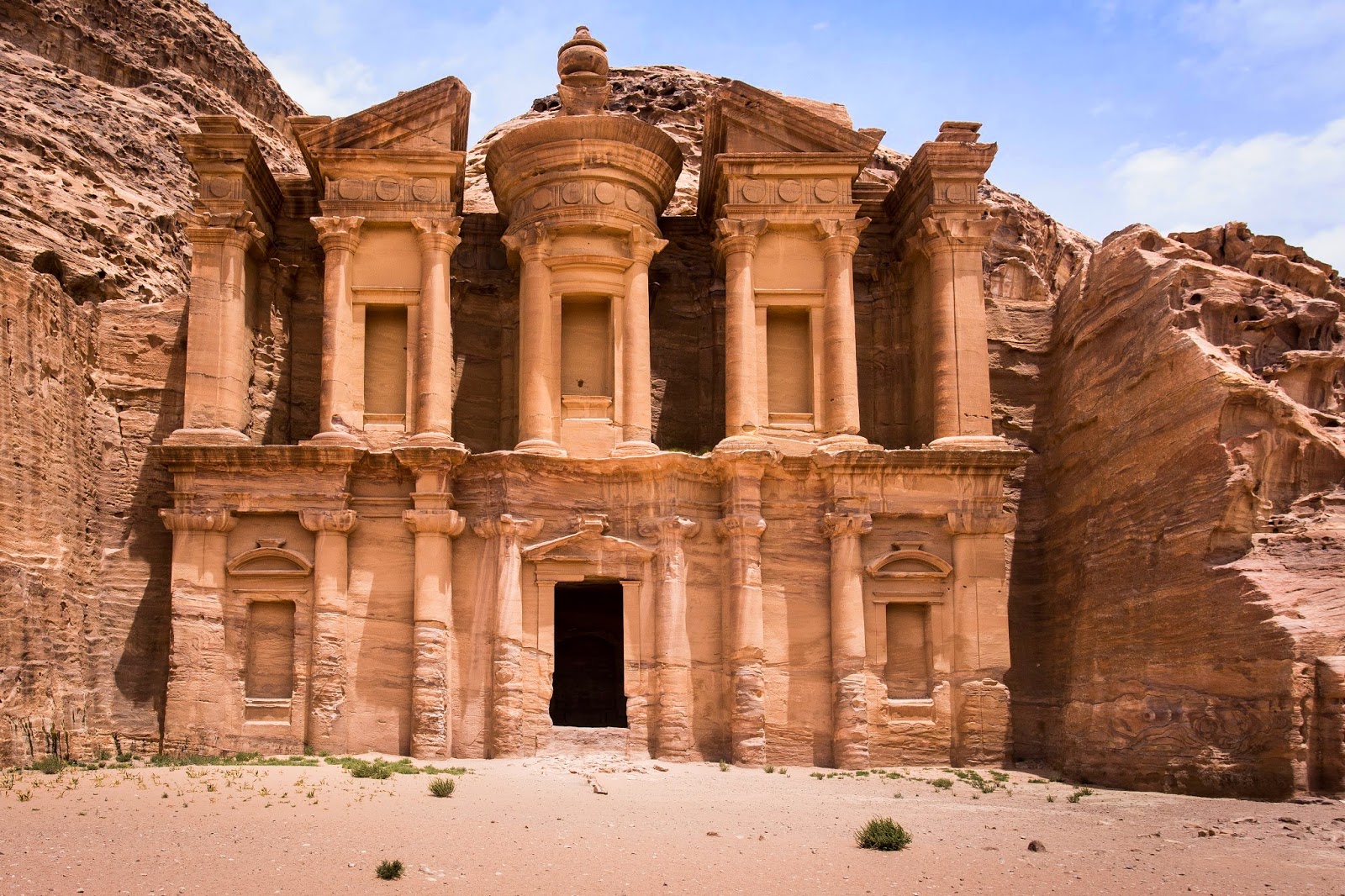
The Monastery; inconveniently located atop cliffs.
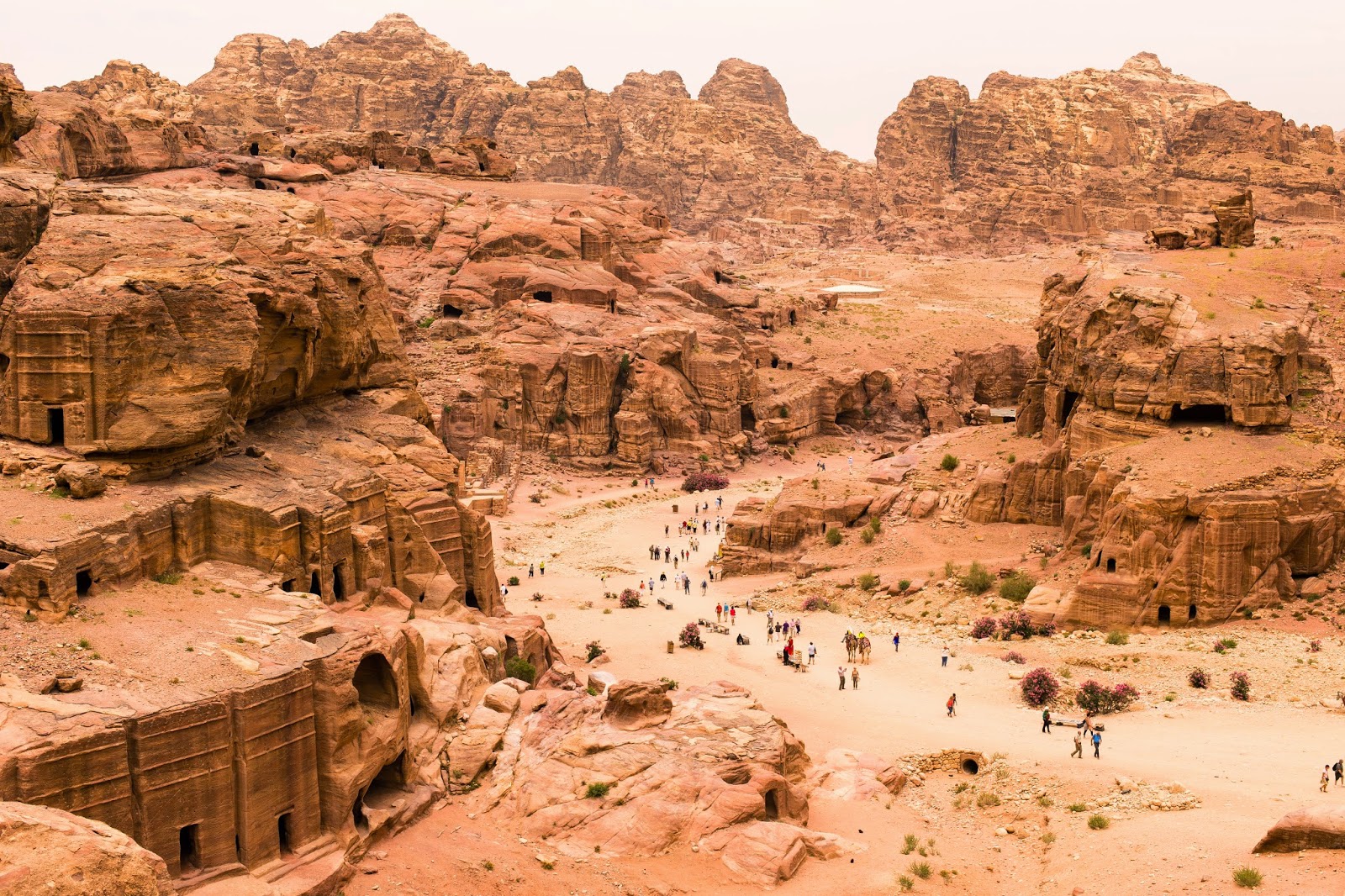
Between these two carvings are several kilometres of smaller but still remarkable tombs and carvings throughout the wadi. Stretching a considerable portion of this length is a colonnaded road that serves as a reminder of its once Roman occupation. Before seeing any of this it was genuinely hard to imagine tens of thousands of people living in a canyon with glorified caves for homes… but now it just seems pretty super.
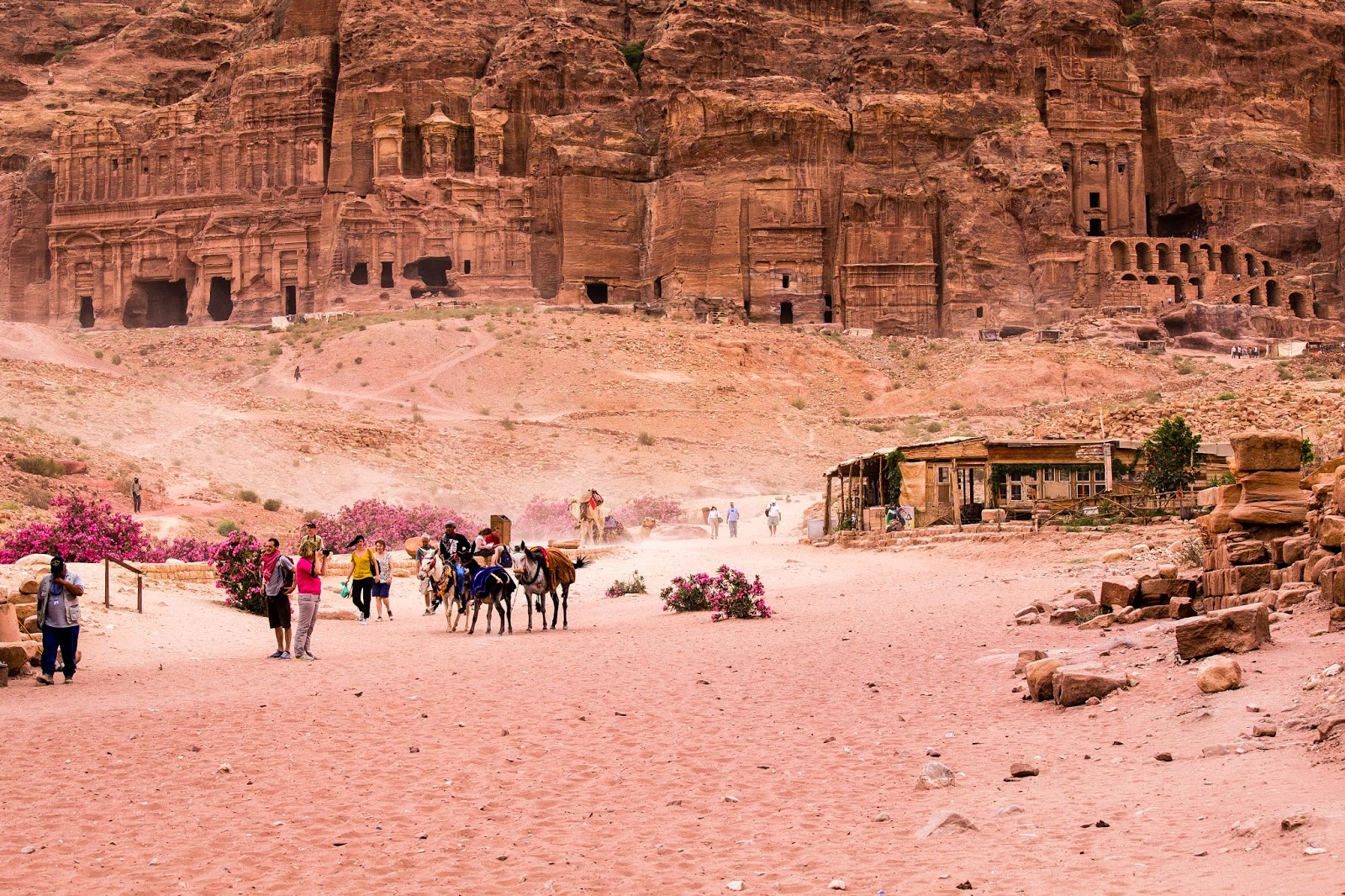
Royal Tombs across the valley.
 
For what it’s worth, the winner of unexpected bonus of the first day is shared by two vile, fat, middle aged American women who engaged in a shrieking match and then some good old fashioned argie-bargie (they stopped short of AFL styled jumper punches, shame). All this over who was next in line for a horse drawn carriage out through the Siq. It’s worth noting that those horse drawn carriages are reserved for the old or infirm and that the Siq is an easy walk through a well sheltered and cool gorge.

I do love those Americans.

With no low hanging fruit left to pick (indeed, even some of the harder stuff disappeared with my trip to the Monastery), the second day became devoted to exploring the trails over the top of the gorges. For this, a guide is required. Mohammed was quick to locate me as I came through the gate whereupon I honoured his seeking me out by engaging his services as a guide. This is where travelling solo absolutely falls down. I alone pay for his time, instead of it being split between a small group. Owing to this, I bargain fiercely, down to a point where I’d refuse me safe in the knowledge that I could run Angela back and forth over three hours and make more. Irrespective of that, the final price still tickles the wallet more than I would really like. Oh well. It’s inescapable.

The trail begins before the Siq, is hard work, practically invisible to me and frequently treacherous. One scramble takes you up thirty or so metres over small loose rocks that makes a mockery of any angle of repose I’d ever seen before and thus is clearly a devilish trap. A slip or misstep here would give you a rapid descent down whatever you’d already scaled before slipping over the edge and plummeting past the face of the Treasury, down some seventy metres before presumably flattening a small tour group. This on tired, groggy legs after having already climbed to the top of the other side of the gorge had me running Admiral Ackbar’s one meaningful line in Return of the Jedi over and over in my head to my scarce amusement.

That said, the view looking down to the Treasury is incredible.
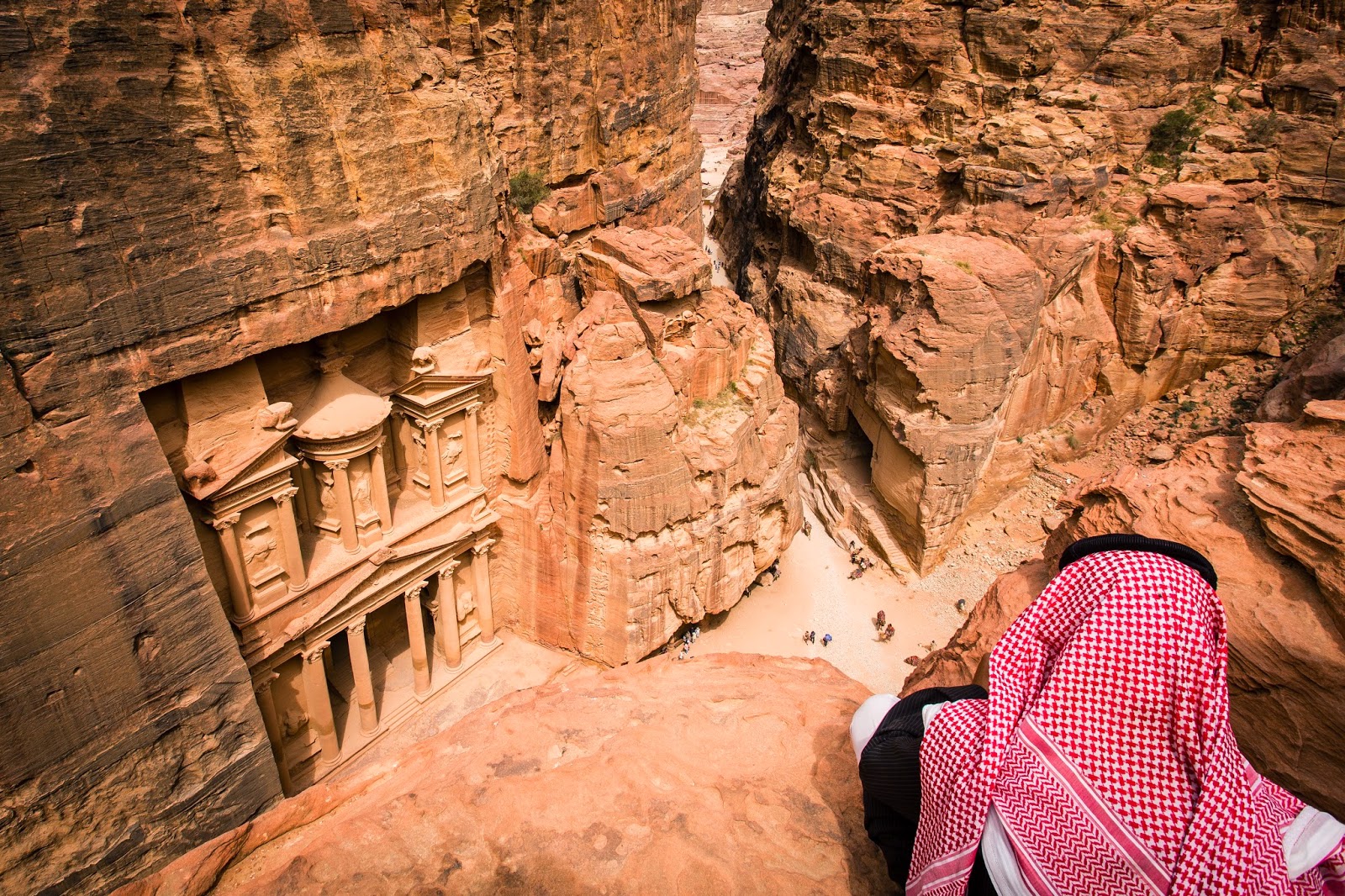
As good a spot as any to have a cup of tea.
After negotiating the loose rocks and ascending to the top, Mohammed leaves me after three and a bit hours of “guidance”, probably realising that this was not his best money making venture. I tipped him an extra 5 dinar (~$10), he asks for more, “for Angela.” It’s probably a fair request but I say no, saying that if she were here I’d gladly give it directly to her. He sees the funny side and leaves, giving me directions to A High Place of Sacrifice.

You have to hand it to Jordanians – or the Nabataeans if it was their name initially – A High Place of Sacrifice says everything it needs to. It is very high and there is an altar atop it that even has plumbing for blood from sacrifices to funnel away and pool elsewhere. What the name omits is that the views here are spectacular. Affording uninterrupted views of Wadi Musa, the scale of Petra unfolds and wows you all over again. From the Monastery perched atop the next mountain range, down that to the ruins of a Roman cathedral, the colonnaded path across the Wadi to the royal tombs overlooking the auditorium and dwellings before the canyon narrows and winds to the Treasury. It’s hard to oversell just how incredible – and audacious – the whole area is, nevermind just the Treasury.

The Treasury.

It’s an absolute crime that so many tour groups walk the Siq, look at the Treasury and then walk back. Heaven forbid anyone do anything adventurous while on holiday.

Do this. Just do this.


Not Angela, not impressed either.


Friday, May 23, 2014

Jordan: Jerash; The Temple of Artemis, Temple of Zeus and Hadrean's Arch

View from Jerash Hippodrome, looking up to the Temple of Artemis

In Sid Meier's Civilisation V – a game that has probably started as many arguments at the Clam Pitt as it has finished – there is an achievement for the civilisation that builds the Temple of Artemis and the Temple of Zeus in the same city.

Now I know why that is; they’re both in Jerash.
 
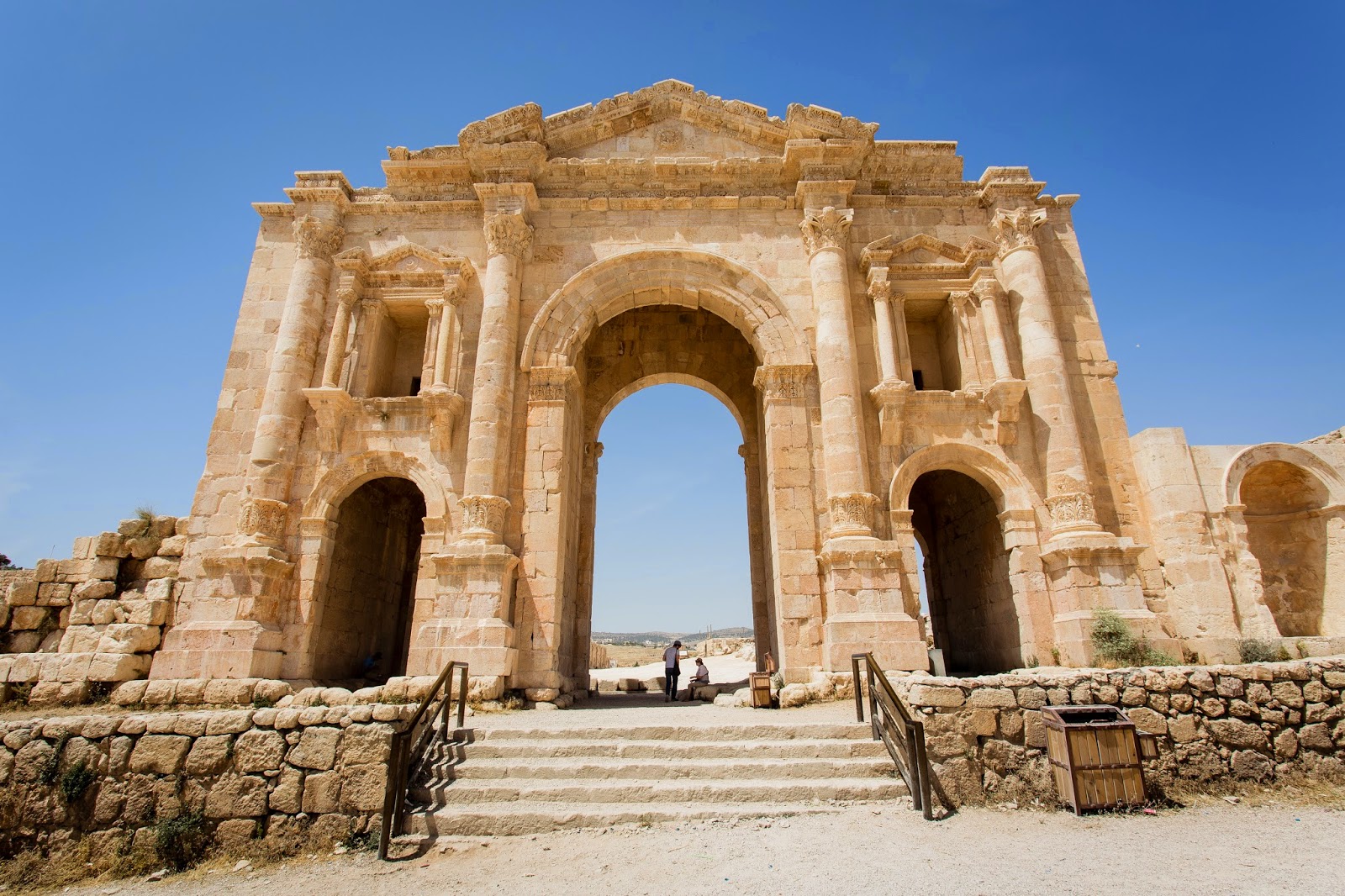
Hadrean's Arch welcomes you to another world.
Walking through Hadrean’s Arch – an impressive monument in itself – the Temple of Artemis is visible in the distance atop a small hill, above a columned parade linking it to a paved circle in the midground. In the foreground on the left is a well preserved hippodrome where gladiators fought and chariots raced. The Temple of Zeus is obscured by this, but overlooks the paved circle atop a different hill. 

A thriving member of the Roman Decapolis (ten reasonably autonomous middle eastern Roman city states 2000 years ago), Jerash fell into ruin in the 8th century after a series of earthquakes. In spite of this, it is broadly considered to be the best preserved Roman city outside of Rome. Allegedly, Crusaders used the Temple of Artemis as a fort at one stage, most likely because it met their exacting requirements of four-ish walls and is notionally on top of a hill. They clearly weren't that fussed by the other taller hills immediately beside it.

Temple of Artemis

Were it not for the conspicuous bins, lights and signs it would be completely otherworldly. The compound is about four kilometres long and maybe half as wide, taking a few hours to explore on foot.

Frankly, it’s fucking awesome.

Within the compound there are mostly intact auditoriums, ruins of cathedrals, the ancient colonnades are incredible and each of the major temples – Artemis and Zeus – are very well preserved. Not unlike Hongcun or Xidi in China walking through here commands considering life in another time, although this takes you back a further millennium.


The Temple of Zeus also would have made an adequate fort!

Thursday, May 22, 2014

Jordan: Amman Citadel and Roman Theatre


For a purportedly ancient city, Amman has very little in terms of ancient ruins preserved, with exception given to the Roman Theatre downtown and the citadel, atop one of the hills adjacent to the down town area. Entrance to these two places is 1JD each – approximately $2 – and there are museums attached to both.

The theatre is easy to find, ancient Roman columns line the walkway in front of it, something that I noticed ahead of lifting my gaze a touch and seeing a very large, stone auditorium built into the side of a very large hill. The rake of the steps is fierce and the seats catch most of the afternoon sun… it can’t be terribly pleasant in the height of summer. Some of the theatre has been a little unfaithfully restored but it’s hardly to the detriment of the overall imposing nature of the venue.

Roman Theatre, looking across the pit.
Roman Theatre, looking down from one of the first class sections. Amman is in the background, the Citadel is atop that hill in the background.
The citadel is a different beast. Given the mazey nature of the hillside streets here, I deferred to a taxi to take me to the top. Some laziness may have also been involved. Abdul, the cabbie, was keen to drum up repeat business and fed me his number rather quickly. His English is passable and driving is less suicidal than most so I pocketed it without telling too many outright lies about his chances at winning a call up.

View from the Citadel. The flag mast pictured is about 120m tall, the flag is about 30m long. It is apparently the largest flag on the planet.
The citadel is essentially an old fort with the ruins of the Temple of Hercules and a mosque within the ruins of the compound. The temple is in poor shape; it’s basically half a wall, a few standing columns and a few more that have toppled and now serve as good benches to sit on while changing a camera lens.

Temple of Hercules (what's left of it, anyway)

And there’s an elbow.

All that remains of the statue of Hercules is an elbow and what might be a fingernail. The fingernail is about the size of my head. Allegedly, the statue stood at approximately 16m.

… that’s a lot of Kevin Sorbo.

The mosque and the ruins around it are much more intact and make for a curious juxtaposition with Amman for a backdrop. The Temple of Hercules, dilapidated as it is sounds a little like a letdown. It most certainly isn’t, but it is really just an appetiser.


Citadel Mosque